


Micro Machines: Tiny Cars, Giant Kitchen-Table Chaos
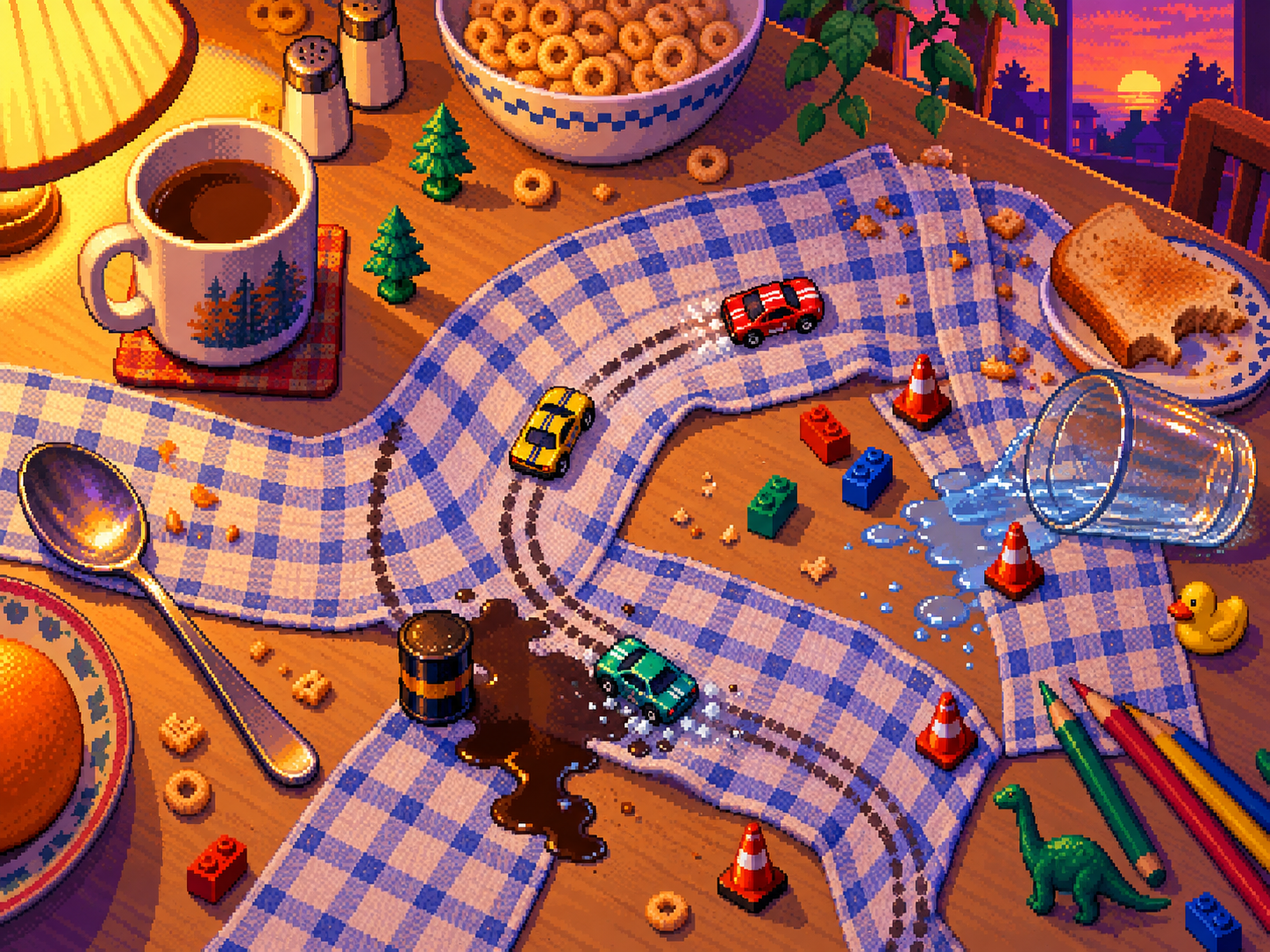 |
| Breakfast, a spilled drink and exactly one too-tight corner. |
Table of Contents 📑
Micro Machines turns ordinary surfaces into impossibly fast racetracks: breakfast tables, desks, bathtubs and garden furniture become worlds for toy-sized vehicles. The series began on NES in 1991; the MS-DOS port arrived in 1994 and was developed by Big Red Software. The release overview lists the DOS version alongside the other ports, while the original manual makes its toy licence unusually explicit: the Micro Machines mark belonged to Lewis Galoob Toys and Codemasters used it under licence.
The central idea is wonderfully mean: this is a top-down racer, but the tight single-screen duel rewards gaining a whole screen length over the other driver, rather than merely counting down a lap timer. The gameplay history explains the resulting colour-light score system and why it was used instead of split-screen.
The useful stuff the game barely tells you
Steer for the car’s direction, not the screen. The manual says left and right rotate the vehicle anti-clockwise and clockwise regardless of whether it currently points up or down. That sounds obvious, but it is the source of many first-lap crashes: resist “screen-left” instincts and steer as though holding a tiny physical car. Original control notes
Use the qualifier as a handling laboratory. The opening Micro Machines Challenge race takes place in a bathtub and is explicitly described as a place to practise. Test the turn-in point with no ambition to win, then repeat with a shorter acceleration burst before the next corner. Original manual: qualifier race
Brake early; reverse is a recovery tool. Holding the fire control accelerates until full speed. Moving down while already travelling forward slows the vehicle; once stopped, it becomes reverse. That makes a tiny correction after a missed corner much cheaper than a wide high-speed loop around the table. Original control notes
Second place is success in Challenge. A first- or second-place finish advances you to another track and vehicle. Third or fourth costs a chance and repeats the course; the run starts with three chances. Treat a safe second as a genuine tactical result, especially on an unfamiliar vehicle class. Original Challenge rules
The route is the real opponent. Every course has a defined path; lingering off it sends a car back onto the circuit. So a dramatic-looking shortcut over crumbs, paper or carpet is usually slower unless it reconnects immediately. The top-down route rule is explained in the gameplay reference.
Head-to-head is a score-light tug-of-war. Both sides begin with four coloured lights. Pull a screen ahead and one light changes to your colour; take all eight, or lead after three laps, to win. A tie goes to sudden death. It means that a clean escape from one corner can matter more than defending every pixel of the lap. Original head-to-head rules
Choose opponents with the campaign in mind. After qualifying, the manual lets you select three opponents, then replace drivers as they drop out. It even advises reserving weaker characters for later rounds. That is a rare bit of tournament planning hiding inside an arcade racer. Original opponent-selection notes
Do not copy random console cheats into DOS. Cheats documented online are often explicitly tied to CD-i, Master System, Game Gear or NES releases—for example, the hard-mode sequences and the secret-credits trick. They are interesting port trivia, but not verified DOS codes. Version-labelled cheat list
A famous bug belongs to the NES original, too. The first race could crash if the player reversed; the fix was a small add-on in affected cartridges. It is a great piece of launch-era lore, but it is not a reason to expect the DOS port to reproduce it. Development history
Play it legally
The surviving DOS manual is useful documentation, but it is not a licence to redistribute the game. I have not found a current authorised DOS download from the rights holders, so the sensible route is original media or a verified authorised re-release if one becomes available. The period manual itself identifies the Galoob trademark licence and Codemasters copyright notice. Manual copyright and trademark page
Sources
- Micro Machines DOS manual — controls, Challenge rules, head-to-head scoring, settings and original rights notice.
- Micro Machines release and development overview — DOS release year, platforms, top-down route mechanic and development trivia.
- GameFAQs version-labelled codes — comparison point for cheats that belong to other ports rather than DOS.
| ⚖ RIGHTS & FAN GUIDE NOTICE |
| Micro Machines. The original DOS manual identifies Micro Machines as a registered trademark of Lewis Galoob Toys, Inc. and credits Codemasters Software Company Ltd. for the game. This independent, non-commercial guide and its original illustration are not affiliated with or endorsed by the trademark or copyright owners. Game software, names, characters and original art remain with their respective rights holders. |